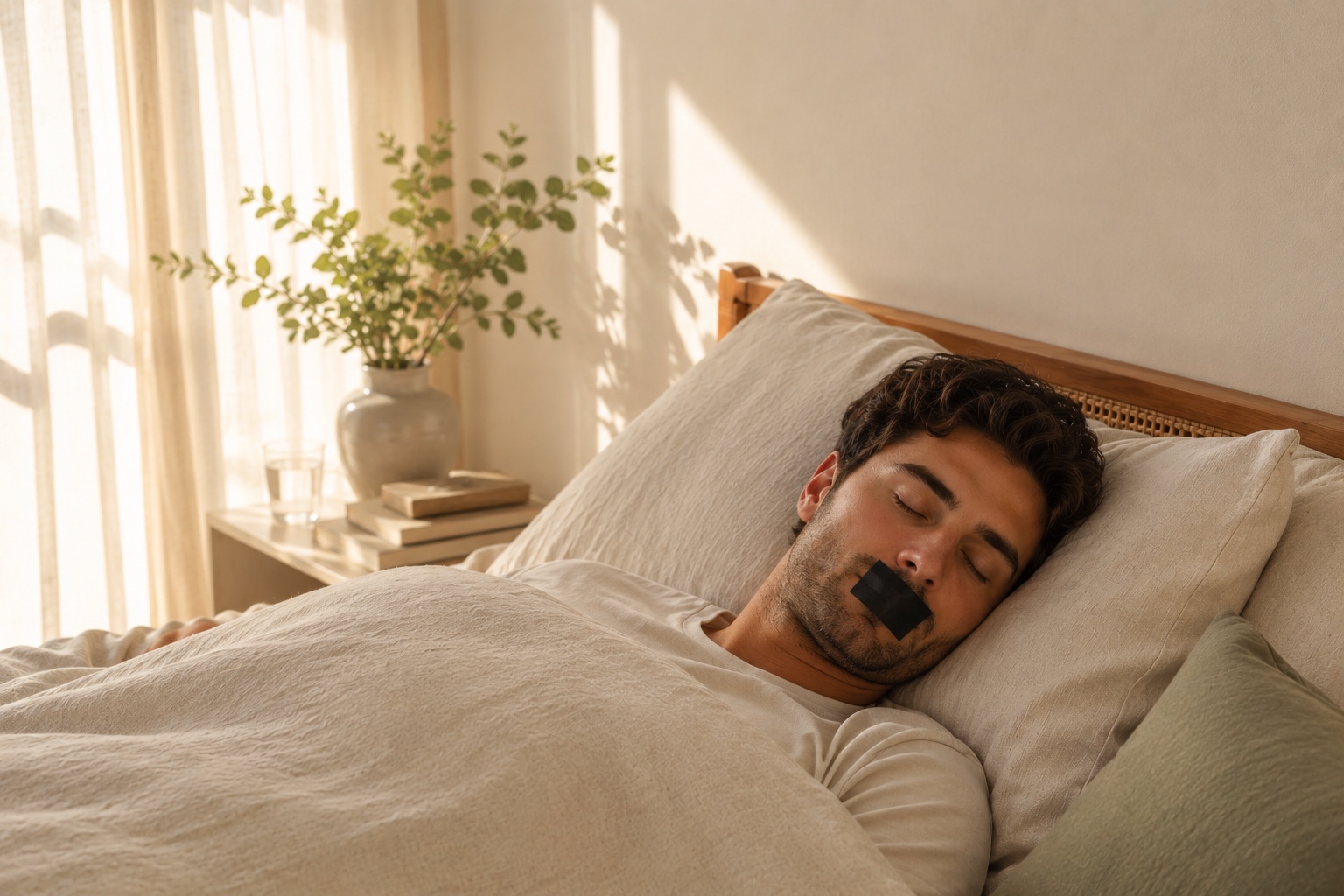
If you've spent any time on social media in the last couple of years, you've probably come across mouth taping — people applying a small strip across their lips before bed, claiming it's transformed their sleep. It sounds unusual if you've never heard of it, so it's worth explaining plainly what it actually is.
What mouth taping actually is
Mouth taping is exactly what it sounds like: wearing a gentle adhesive strip across closed lips overnight. It's not a medical device and it's not designed to force anything — it's a lightweight strip, applied to clean, dry skin, that holds your lips gently together while you sleep and can be removed at any time.
The idea behind it
The rationale is about encouraging nasal breathing. Left to its own devices, the mouth tends to fall open during sleep, especially once you're deeply relaxed — and breathing through an open mouth skips the filtering, warming, and humidifying that nasal breathing provides, while also being a common contributor to snoring and a dry mouth by morning. Mouth tape is designed to gently keep the lips closed, so your body defaults back to breathing through the nose instead.
Does it work? What we can honestly say
Here's the balanced answer: there's a reasonable, well-established case for why nasal breathing itself is beneficial for sleep. What's less established is mouth taping specifically as a technique — it's a newer trend, and formal research on it directly is still limited. Most of what we know comes from individual experience rather than large clinical studies, so it's fair to describe it as a promising, low-risk habit rather than a proven treatment.
Where the idea came from
Mouth taping isn't entirely new — versions of it have been discussed in breathing and wellness circles for years — but it found a much wider audience through social media, where people began sharing before-and-after accounts of feeling less groggy, snoring less, or simply sleeping more soundly. That kind of personal testimony is what's driven most of its popularity, rather than any single study or endorsement, which is part of why it's worth approaching with realistic expectations rather than treating it as a guaranteed fix.
What it feels like in practice
Most people describe an adjustment period of a night or two, after which the strip becomes easy to forget about. It's designed to be comfortable enough to sleep through and simple enough to remove instantly if needed — no force, no restriction, just a gentle nudge in the right direction. Some people notice a difference within the first few nights; for others it's more gradual, becoming apparent over a week or two of consistent use as nasal breathing starts to feel like the default rather than something they're having to think about.
A few practical questions people ask
Can you still talk or cough if you need to? Yes — a well-designed strip holds your lips together gently rather than sealing them shut, so you can still open your mouth if you need to. Is it hygienic to reuse a strip? No — like any adhesive product, each strip is designed for single use and should be discarded in the morning. Does it work for everyone? Not necessarily; people who breathe well through their nose already tend to notice the smallest difference, since there's less to change, while people whose mouth breathing is more habitual than necessary tend to notice more.
If you want the fuller picture — including who should be cautious before trying it — we've written a more detailed look at where the trend gets it right, and where to be careful. If you're ready to try it, Drift Easy Mouth Tape is designed exactly for this.